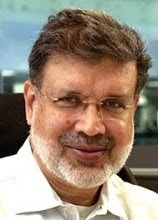
The Finance Minister gives with one hand, and takes away with the other. Income-tax exemption limits are raised marginally, but you will get hit on more items for service tax. And this is assuming that your food costs will drop a bit if Pranab Mukherjee's 300-crore magic formula works. For the full post go to http://bit.ly/indiabudget2
Showing posts with label Pranab Mukherjee. Show all posts
Showing posts with label Pranab Mukherjee. Show all posts
Monday, February 28, 2011


Fussbudget
Far away in Los Angeles, “The King’s Speech” won four Oscars, including Best Picture and Best Actor, just as Pranab Mukherjee rose to present the Union Budget for 2011-12 in Parliament. The finance minister spoke for 110 minutes, but certainly does not win any prizes for dramatically pushing India’s reforms into a new geostationary orbit.
...for the rest of my post go to http://bit.ly/pranabthree
...for the rest of my post go to http://bit.ly/pranabthree
Wednesday, February 16, 2011
It’s the elections, stupid
Pranab Mukherjee is starting to look worryingly like a feckless heir squandering his generous inheritance while his fretful guardian in the person of Duvvuri Subbarao tries to board up the door and keep the wolves at bay with a nail here and a nail there.
The “history sheet” is simple and clear. Later this month, Mukherjee will present his third budget since the United Progressive Alliance came to power in the 2009 election. UPA-I, by hugely increasing social-sector expenditure in its two final years, 2007-2009, effectively torpedoed the Fiscal Responsibility and Budget Management Act, which mandates that fiscal deficit be cut to 3 per cent of GDP by 2008/09.
India’s financial mandarins argued that fiscal stimulation was called for to battle the global downturn and to deepen “inclusive” growth. The fiscal deficit shot up to 6.0 per cent in 2008/09, 6.7 per cent in 2009/10, and is projected at 5.5 per cent in 2010/22. As a Royal Bank of Scotland analysis put it, even if you take the windfall from the 3G spectrum auction into account, achieving next year’s 4.8 per cent target seems impossible. And to think that back in 2004, flush from its victory, the UPA actually predicted a balanced budget by 2008/09.
Experts will tell you that once the economy had come through the recessionary shoals, the aam admi stimulus ought to have been pulled back and more funds poured into infrastructure and manufacturing. Instead, populist spending is only likely to increase, said Dr Rajiv Kumar, Director General of the Federation of Indian Chambers of Commerce and Industry, or FICCI. Mukherjee, ever the fixer-upper for the Congress party, will have to keep an eye out for five key state elections this summer, including West Bengal, Tamil Nadu and Kerala. The spending cannot stop. The Uttar Pradesh state election in 2012 will call for some huge sops. Then comes 2013, and the general election – assuming the UPA government is still in power, scandals, legislative gridlock and all.
An international economist who closely watches India said with ample revenues in its coffers, the fiscal situation ought to have improvc1ed. “But it is not. Instead, all the revenues (and more) are being spent on new social programmes. Now it is true that social indicators are poor, and more needs to be done to help the poor. But it is hard to avoid the impression that the government sees the poor as vote banks, which they can tap as long as they provide them with funds. And surely at least a portion of the revenues could be saved, to give India some manoeuvring room in case a crisis hits?”
“There has been too much stoking up of consumption demand,” said Kumar, “and not enough capacity expansion.” The central bank, too, says only by spending more on capital expenditure will the government be able to fight some of the bottlenecks that contribute to supply-side inflation.
Inflation is now entrenched, and food price inflation is here to stay, fuelled by rising consumption of proteins as buying power increases in the countryside. The RBI’s review of the September-December 2010 economy commented drily that “The rise in food inflation has not only persisted for more than two years now, the increase has been rather sharp in the recent period.” And Subbarao, in his January 25 statement after the central bank raised interest rates for the seventh time this fiscal year, said: “Food inflation has remained at an elevated level for about two years and the prospect of it spilling over to the general inflation process is rapidly becoming a reality.” And so the RBI has raised its estimate for inflation to 7.0 per cent by March-end.
“If you chart inflation, there seems to be a clear break in 2006. Before that, inflation wasn't much of a problem; since then, it has been. Initially much of this was because of food price increases. But now prices are rising more widely, and it is hard not to conclude that monetary policy needs to be tightened substantially, so we can put inflation ‘back in the box’,” Joshua Felman, a former International Monetary Fund, or IMF, representative in India, said.
But monetary policy is a blunt instrument to beat inflation over its head with. The RBI rubbed this in: “Monetary policy works most efficiently while dealing with an inflationary situation when the fiscal situation is under control.”
Because of poor storage and infrastructure, there are huge productivity losses. “And supply is unable to keep up,” said Kumar. “At the same time, cereal yields have been stagnating.” A Nomura paper on food prices last September noted that the food weighting in consumer price inflation, or CPI, in advanced economies was typically between 10 and 20 per cent, whereas it was about one-third in China and as high as 46 per cent in India. “A sustained surge in food prices can have more pernicious effects if it unmoors inflationary expectations, impelling workers to demand higher wages to compensate for rising food costs, thus setting off a wage-price inflation spiral,” the Nomura report said. This is exactly what is happening in India.
With bank lending rates upward of 11 per cent, manufacturers face a nasty squeeze. FICCI’s Kumar pointed out that 90 per cent of State Bank of India lending over the past three quarters went towards infrastructure projects, and only 10 per cent went to manufacturing. “The cost of capital is likely to go up further,” said Kumar.
Dr Chakravarty Rangarajan, Chairman of the Prime Minister’s Economic Advisory Council, said food inflation has been a problem for over two years. “In a situation like this, management of the supply side is critical,” he told Business Today. In mitigation, Rangarajan said, prices of cereals like wheat and pulses have dropped, but the prices of meat, fish, eggs, vegetables and fruit have risen sharply.
Felman, who now works in the IMF’s research department in Washington, D.C., said he was worried about whether investment is truly recovering. “Here the signs are very mixed. Credit is growing nicely, and infrastructure projects such as power and roads seem to be moving ahead. But other greenfield projects seem stuck, held back by investor caution, land issues and the complex process of securing environmental clearances. So, investment does not seem to be booming the way it was before the crisis, and this is worrisome.”
The RBI’s quarterly review echoed with warnings. The current-account deficit, or CAD, will hit 3.5 per cent this fiscal year, and is “unsustainable”, the central bank said. But with global commodity prices rising, import bills look like staying high. Foreign direct investments, or FDI, could help finance this deficit, but the bad news is that FDI flows into construction, real estate, business and financial services have declined, while foreign institutional investors’ equity investments accounted for 79 per cent of net capital inflows of $36.7 billion during April-September 2010. This is clearly not desirable or sustainable, and the central bank said that “environment sensitive policies” – read Jairam Ramesh’s activism – have triggered a fall-off in FDI. “Added to this are the persistent procedural delays, land acquisition issues and availability of quality infrastructure,” the RBI said.
Will the UPA government quicken reforms to address these problems? The international economist was not sanguine. “Everyone expected that once the Left Front was kicked out of the coalition, reforms would accelerate. Instead, they've slowed down,” he said.
The IMF’s Felman said his final concern was the “governance deficit”. “A decade ago the question for reformers was whether the government would give the market sufficient space to operate,” he says. “Now, the issue is the reverse: whether the government has sufficient room to do what it needs to do, namely set fair rules of the game in which firms would operate. In a nation where there are more than one billion competing people, each striving for a fair chance in life, this is not just a problem. It is a tragedy.”
Saturday, August 1, 2009
Sharm el-Sheikh and appeasement: a lesson in history
O tempora! O mores! Were that
Leader after leader of the world’s biggest democracy is standing up to be counted with words that can only be described as desperation wrapped in dementia inside dyslexia.
“We have nothing to hide”; “We are an open book”. And, the day after Manmohan Singh delivered a courageous defence of the joint statement that has brought him so much vexation, Finance Minister Pranab Mukherjee made a speech in parliament that excoriated all the doubters.
And then Mukherjee said something that would make students of history blanch:
“Everybody knew that before the Second World War when Chamberlain entered into the Munich Pact, that it is not going to succeed, but it was considered necessary because they thought that the last effort should be made to save the world from the impending Second World War. This is the lesson of diplomacy, which we should not forget.
Dear, dear Pranabda. He was barely three years old when Neville Chamberlain gifted Hitler the Sudetenland, the border area in
Chamberlain told his people he had averted war. He was proud of his appeasement and believed he had given Hitler what seemed to be his “reasonable” demand. After all, the same year (1938) Time magazine voted Hitler the Man of the Year.
Mukherjee can be forgiven for not remembering Chamberlain’s words: “However much we may sympathise with a small nation confronted by a big and powerful neighbour … If we have to fight, it must be on larger issues than that. I am myself a man of peace to the depths of my soul; armed conflict between nations is a nightmare to me... War is a fearful thing, and we must be very clear before we embark on it, that it is really the great issues that are at stake.” (emphasis mine)
Ringing words. And ringing words were what Prime Minister Singh delivered in parliament on July 29. “I say with strength and conviction that dialogue and engagement is the best way forward,” he said. And later, “Let me say that in the affairs of two neighbours we should recall what President Reagan once said – trust but verify. There is no other way unless we go to war.”
Let us refresh our memories on what the Sharm el-Sheikh joint statement said. "Action on terrorism should not be linked to the Composite Dialogue process and these should not be bracketed. Prime Minister Singh said that
That bit of “bad drafting”, as Foreign Secretary Shiv Shankar Menon so helpfully put it, was followed by a wan ruling party damning the prime minister with ten days of silence and then a pallid statement earlier this week that left it to him to hoist himself out of trouble.
The opposition outcry was led by the Bharatiya Janata Party, and what a glorious example they set! Atal Behari Vajpayee's peace-making bus trip to Lahore in early 1999 was followed by the Kargil war, which Pervez Musharraf now proudly says forced India to discuss Kashmir (ergo, "all outstanding issues" above).
I well remember the ignominy of shepherd boys noticing that all the commanding heights along the Srinagar-Leh highway had been quietly occupied by heavily-armed Pakistani "irregulars". (Ten years ago the Pakistanis had not learnt phrases like "non-state actors"). And Musharraf, who gave
Anybody reporting on Kargil in 1999 knows that the Pakistanis agreed to end their "aggressive patrolling" -- another piece of doublespeak from Musharraf -- only after U.S. President Bill Clinton twisted Pakistani Prime Minister Nawaz Sharif's arm in
The sub-text in 1999 was the West’s fear that
Five months after Kargil, Pakistan-nurtured “freedom fighters” again put
Nothing daunted, Vajpayee invited Musharraf to the
Again and again,
The travesty is that Musharraf did underwrite secret talks between his emissaries and Indian envoys that brought the neighbours within sight of a tantalising
Manmohan Singh made an admirable speech on Wednesday. It was a good speech from a man of peace. But the genteel negotiators of
(This column appeared in Khaleej Times on August 1, 2009)
Friday, July 10, 2009
The Secret Life of the Manic Depressive Market
Not very long ago I watched a fascinating documentary by Stephen Fry on manic depression. I was reminded about the rollercoaster mood swings of people in that movie as I watched the markets on Budget Day. Panel after panel of pundits debated why the budget had not delivered the flavourful cocktail they thought the people had been thirsting for. Although the salaried class, senior citizens and women wage-earners benefited from some tax trimming, the consensus was that this was not a go-for-it reform budget.
Wait a minute – so the speculators and the day-traders and the swashbucklers were caught with their shorts down. Public memory is very short. People have forgotten that the Bombay Sensex rocketed 52.57 % between January 1 and June 30 this year. In comparison, the Dow Jones Industrial Average has actually fallen from 9034 on January 1 to 8447 on June 30. And
So the journey of the Sensex this year can only be described as manic. Did the fundamentals merit this kind of irrational rise – or Monday’s depressive fall?
Nobody really knows how badly the aam admi, the common Indian, has been hit – 92% of the workforce is in the “informal” or unorganised sector, so unemployment figures are poor estimates. Anecdotally, it is clear that millions of people have lost their jobs in the gems and jewellery, textile, leather and small and medium enterprise sectors.
Another indicator is the massive slowdown in industrial production, to 2.4% in 2008/09 from 8.5% a year earlier. Exports and imports both declined sharply; the trade deficit ballooned 35% to $119 billion, and foreign exchange reserves declined by nearly 17% to $262 billion at end-May.
Mukherjee listed several steps to aid exporters. But internal investment has plunged -- growth in fixed capital formation declined from 12.9 % in 2007-08 to 8.2% in 2008/09. External commercial borrowings dried up, capital accretion through the stock markets slowed to a trickle, and banks became much more reluctant to lend.
How many people exactly are out of work in
Unemployment among farm workers rose to 15.3% in 2004/05. Growth in real wages of farm workers slowed down in the 2000s as agricultural growth decelerated.
The Planning Commission estimated in 2007 that the number of unemployed totalled 36.7 million in 2006/07. It predicted optimistically that this would fall to 23.3 million in 2011/12. But that was before the global crisis. “This growing integration of the Indian economy with the rest of the world has brought new opportunities and also new challenges. It has made the task of sustaining high growth more complex,” Pranab Mukherjee said, almost ruefully.
Instead of bold changes in direction, the finance minister announced he would pump even more money -- Rs 39,100 crores ($8.3 billion) or a 144% increase over 2008/09 -- into the National Rural Employment Guarantee Scheme, which created jobs for 44.7 million people last year. This is going to be even more critical given that growth in the agriculture sector slumped to 1.6% in 2008/09 from 4.9% a year earlier.
So there may not have been breathtaking reforms, but there was plenty of stimulation, totalling Rs 186,000 crore ($39.6 billion) in 2008/09, and that pushed up the fiscal deficit to 6.2 % of GDP. That will rise further to 6.8% of GDP in 2009/10 – the finance minister proudly remarked that government expenditure will exceed 10.2 trillion rupees ($217 billion) this fiscal year, a leap of 36% over last year. That is going to be fuelled by a 50% rise in government borrowing. After his speech, Mukherjee told a TV interviewer that this was not too alarming because the
Actually, as the RBI noted in its April policy statement, the combined Central and State fiscal deficits, plus special securities issued by the centre outside the market borrowing programme, will take the nation’s fiscal deficit to 10.8% of GDP. No wonder the ratings agencies are getting more and more twitchy by the day, and that Mukherjee said the challenge of recovery has to be shouldered jointly by the centre and the states.
“The deficit is too high and
Mukherjee said net market borrowings are likely to hit Rs 400,000 crores in 2009/10. In the first half of this fiscal year alone, the RBI has committed itself to purchase government securities under open market operations to the tune of Rs 80,000 crores. In the absence of a corporate-bond market, this means that “real interest rates” will be unrealistically high for companies who are getting muscled out of the debt markets by the government-central bank behemoth.
Mukherjee pledged to return to the “path of fiscal consolidation at the earliest”. But his ministry’s Economic Survey, published last week, said it might be time to go for an “FRBM-2” of zero fiscal deficits.
The stimulation cannot be denied – the Sixth Pay Commission is estimated to have pumped close to an additional Rs 117,000 crores ($25 billion) into government employees’ wallets since last October, and may have added 1.1 percentage points to GDP.
The OECD predicted last month that
But the past year has laid to rest the myth that
(This piece appeared in the Khaleej Times on July 10, 2009)
Subscribe to:
Posts (Atom)